
Langkah Cepat Menghadapi Sengketa Tanah
- Jangan melakukan tindakan sepihak (memindahkan patok, menjual, atau menguasai secara paksa).
- Kumpulkan sertifikat, alas hak, akta, bukti pembayaran, dan bukti penguasaan fisik.
- Susun kronologi dan identifikasi pihak yang bersengketa.
- Periksa data fisik (letak, luas, batas) dan data yuridis (jenis hak, riwayat peralihan).
- Coba musyawarah atau mediasi — jalur non-litigasi lebih cepat dan murah.
- Ajukan pengaduan ke Kantor Pertanahan bila relevan dengan administrasi pertanahan.
- Konsultasikan gugatan ke pengadilan jika penyelesaian non-litigasi gagal atau tidak sesuai.
Apa Itu Sengketa Pertanahan?
Sengketa pertanahan adalah perselisihan mengenai hak, batas, penguasaan, penggunaan, pemanfaatan, atau administrasi tanah antara dua pihak atau lebih. Sengketa bisa terjadi antarindividu, antaranggota keluarga, antar badan hukum, maupun antara masyarakat dengan negara.
Dalam praktik, satu bidang tanah dapat diklaim oleh lebih dari satu pihak karena:
- Riwayat peralihan hak yang tidak tercatat dengan baik;
- Kesalahan administrasi dalam penerbitan sertifikat;
- Dokumen lama (girik/letter C) yang masih dianggap sebagai bukti kepemilikan;
- Warisan yang belum dibagi secara sah;
- Tumpang tindih antara tanah adat/ulayat dengan hak perorangan.
Penting untuk membedakan sengketa (perselisihan hak), konflik (intensitas lebih tinggi, sering melibatkan kekerasan atau politik), dan perkara (sengketa yang sudah masuk proses pengadilan).
Penyebab Utama Sengketa Tanah
- Jual beli bermasalah (akta tidak sah, objek tidak jelas);
- Sertifikat tumpang tindih (satu bidang tercakup dalam dua atau lebih sertifikat);
- Batas tanah tidak jelas atau patok bergeser;
- Pemalsuan dokumen (sertifikat, akta jual beli, surat kuasa);
- Sengketa warisan (ahli waris tidak sepakat);
- Tanah belum bersertifikat (girik, letter C, petok);
- Tanah dikuasai pihak lain secara sepihak (penyerobotan);
- Hibah atau wakaf yang dipersoalkan;
- Kesalahan administrasi pertanahan;
- Konflik tanah adat atau ulayat;
- Wanprestasi dalam transaksi tanah;
- Keputusan pejabat pertanahan yang dipersoalkan (misalnya penerbitan sertifikat yang dianggap cacat).
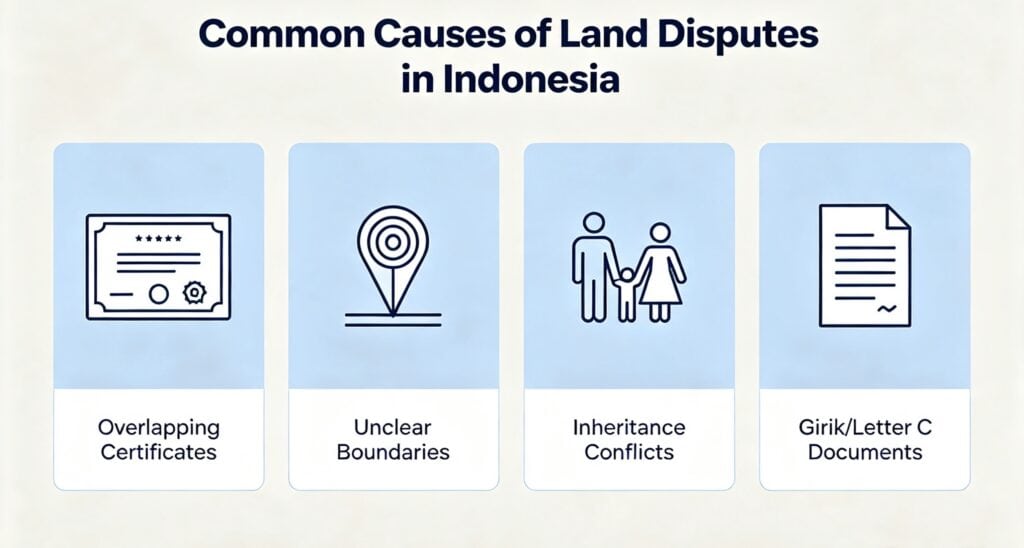
Penyebab sengketa tanah sangat beragam — kenali jenis masalah Anda sebelum menentukan langkah.
Tentukan Jenis Sengketanya Terlebih Dahulu
Jangan langsung memilih jalur penyelesaian sebelum mengetahui jenis masalah yang Anda hadapi. Setiap jenis sengketa memiliki jalur dan bukti yang berbeda.
| Jenis Masalah | Contoh | Jalur Awal yang Mungkin |
|---|---|---|
| Batas tanah | Patok atau luas dipersoalkan | Pengukuran ulang, musyawarah, Kantor Pertanahan |
| Kepemilikan | Dua pihak mengklaim hak atas tanah yang sama | Pemeriksaan alas hak, mediasi, gugatan perdata ke PN |
| Sertifikat tumpang tindih | Satu bidang tercakup dalam beberapa sertifikat | Pengaduan ke BPN → pemeriksaan administratif → PTUN jika perlu |
| Tanah belum bersertifikat | Girik, letter C, atau bukti penguasaan diperselisihkan | Desa/kelurahan, Kantor Pertanahan, mediasi, perdata |
| Warisan | Ahli waris tidak sepakat mengenai pembagian | Dokumen waris, musyawarah, mediasi, Pengadilan Agama atau PN |
| Penguasaan fisik | Tanah ditempati pihak lain tanpa hak | Somasi, negosiasi, gugatan perdata (PMH) |
| Administrasi pemerintahan | Keputusan pejabat pertanahan dipersoalkan | Upaya administratif → PTUN |
| Dugaan pidana | Pemalsuan atau penipuan dalam dokumen tanah | Konsultasi hukum → laporan ke polisi jika unsur terpenuhi |
Bagian ini harus dibaca sebelum Anda memilih solusi — tidak semua sengketa harus diselesaikan dengan cara yang sama.
Langkah Pertama Menghadapi Sengketa Tanah
Jangan Menjual atau Mengalihkan Tanah
Buat Kronologi Tertulis
Gunakan template berikut:
- Tanggal dan cara memperoleh tanah;
- Identitas pihak yang menyerahkan atau menjual;
- Dokumen yang ditandatangani (AJB, PPJB, hibah, waris);
- Bukti pembayaran;
- Tanggal penerbitan sertifikat (jika ada);
- Kapan dan bagaimana klaim pihak lain muncul;
- Komunikasi yang telah dilakukan dengan pihak lawan;
- Kerugian yang dialami;
- Solusi yang diinginkan.
Amankan Bukti
Checklist dokumen yang wajib dikumpulkan:
- Sertifikat hak atas tanah (SHM, SHGB, HGU, dll.)
- Surat ukur atau gambar situasi
- AJB, PPJB, hibah, surat wasiat, atau akta waris
- Girik, letter C, petok, atau dokumen lama lainnya[reference:12]
- Bukti pembayaran (kwitansi, transfer bank)
- SPPT PBB (pajak bumi dan bangunan)
- Surat keterangan desa/kelurahan
- Foto dan video kondisi lapangan serta patok batas
- Bukti penguasaan fisik (listrik, air, bangunan)
- Pesan, email, atau surat menyurat dengan pihak lain
- Nama dan alamat saksi yang dapat dipercaya
- Putusan atau dokumen pengadilan (jika sudah ada)
Periksa Status Tanah Sebelum Menentukan Jalur Hukum
Periksa Data Fisik
- Letak tanah (alamat, koordinat, blok, nomor bidang);
- Luas tanah sesuai surat ukur vs kondisi lapangan;
- Batas-batas tanah (utara, selatan, timur, barat);
- Peta bidang dan kesesuaian dengan patok di lapangan;
- Surat ukur (apakah masih berlaku dan sesuai).
Periksa Data Yuridis
- Jenis hak atas tanah (Hak Milik, HGB, Hak Pakai, dll.);
- Nama pemegang hak yang tercatat;
- Dasar penerbitan sertifikat (riwayat peralihan);
- Adanya hak tanggungan, blokir, atau sita;
- Catatan administrasi lain di Kantor Pertanahan.
Pemeriksaan Melalui Pihak Terkait
- Kantor Pertanahan (BPN) — untuk data resmi dan riwayat sertifikat;
- PPAT atau notaris — untuk memeriksa keabsahan akta;
- Pemerintah desa/kelurahan — untuk data kependudukan dan riwayat penguasaan;
- Advokat — untuk analisis awal dan strategi;
- Ahli ukur atau ahli pertanahan — jika diperlukan pemeriksaan teknis.
Jalur Penyelesaian Sengketa Pertanahan
Secara umum, penyelesaian sengketa tanah di Indonesia dibagi menjadi dua jalur utama: non-litigasi (di luar pengadilan) dan litigasi (melalui pengadilan).
| Jalur | Cocok Untuk | Lembaga/Pihak | Hasil yang Mungkin | Keterbatasan |
|---|---|---|---|---|
| Musyawarah | Para pihak masih terbuka berdamai | Para pihak, desa, tokoh masyarakat | Kesepakatan tertulis | Tidak efektif jika pihak menolak |
| Negosiasi | Sengketa transaksi atau batas | Para pihak/kuasa | Perjanjian penyelesaian | Harus memastikan kewenangan dan legalitas |
| Mediasi BPN | Sengketa terkait data/administrasi pertanahan | Kantor Pertanahan (BPN) | Kesepakatan atau rekomendasi sesuai kewenangan | Tidak selalu memutus seluruh hak keperdataan |
| Mediasi pengadilan | Perkara perdata yang sudah didaftarkan | Pengadilan dan mediator | Kesepakatan atau perkara berlanjut | Terikat prosedur perkara (wajib berdasarkan PERMA No. 1/2016) |
| APS/ADR | Sengketa yang dapat diselesaikan di luar pengadilan | Mediator, konsiliator, arbiter | Kesepakatan atau putusan arbitrase | Tidak semua sengketa cocok untuk arbitrase |
| Pengadilan Negeri (PN) | Klaim kepemilikan, wanprestasi, PMH | Pengadilan Negeri | Putusan perdata berkekuatan hukum tetap | Membutuhkan bukti kuat, biaya, dan waktu |
| PTUN | Keputusan/tindakan administrasi pemerintahan tertentu | Pengadilan Tata Usaha Negara | Putusan administrasi (pembatalan sertifikat, dll.) | Forum dan tenggat harus diperiksa (90 hari sejak keputusan diketahui) |
| Jalur pidana | Dugaan pemalsuan, penipuan, atau tindak pidana lain | Kepolisian/kejaksaan/pengadilan pidana | Proses dan putusan pidana | Tidak otomatis menentukan pemilik tanah (aspek perdata terpisah) |
Cara Menyelesaikan Sengketa Melalui Musyawarah
Kapan Musyawarah Layak Dicoba?
- Batas dapat diukur ulang dan para pihak masih bertetangga baik;
- Masalah terjadi karena salah komunikasi, bukan niat jahat;
- Ahli waris masih memiliki hubungan keluarga dan keinginan untuk rukun;
- Ada ruang untuk kompensasi atau pembagian yang adil;
- Tidak ada indikasi pemalsuan atau penipuan serius.
Cara Melakukan Musyawarah yang Efektif
- Undang pihak secara tertulis — berikan waktu dan tempat yang jelas.
- Bawa dokumen, bukan hanya klaim lisan — tunjukkan bukti.
- Gunakan mediator netral (kepala desa, tokoh adat, atau pihak ketiga yang disepakati).
- Pisahkan fakta, tuntutan, dan pilihan solusi — jangan campur emosi.
- Buat notulen setiap pertemuan sebagai catatan resmi.
- Tuangkan hasil dalam perjanjian tertulis yang ditandatangani para pihak.
- Periksa pengesahan atau tindak lanjut yang dibutuhkan (misalnya pendaftaran ke BPN atau pengadilan).
Cara Mengajukan Pengaduan ke Kantor Pertanahan (BPN)
Dokumen Pengaduan
- Identitas pengadu (KTP, NPWP jika ada);
- Surat kuasa jika diwakilkan;
- Uraian kronologi singkat tetapi jelas;
- Identitas objek tanah (letak, luas, nomor bidang);
- Bukti kepemilikan atau penguasaan (sertifikat, girik, AJB, dll.);
- Bukti pendukung (foto, peta, surat desa);
- Tuntutan atau permohonan yang jelas.
Pengaduan diajukan ke Kantor Pertanahan setempat melalui loket pelayanan atau layanan pengaduan yang tersedia.
Tahapan Penanganan BPN
Berdasarkan Peraturan Menteri ATR/BPN No. 21 Tahun 2020, penanganan sengketa di BPN melalui tahapan sebagai berikut:
- Penerimaan pengaduan — pengaduan dicatat dan diberi tanda terima.
- Registrasi dan pemeriksaan administratif — kelengkapan dokumen diverifikasi.
- Pengkajian kasus — analisis awal oleh analis hukum pertanahan.
- Analisis kewenangan — apakah BPN berwenang menangani atau perlu dirujuk ke forum lain.
- Gelar awal — pembahasan internal untuk menentukan pendekatan.
- Penelitian data dan/atau pemeriksaan lapangan — verifikasi data fisik dan yuridis.
- Pemanggilan atau klarifikasi para pihak — para pihak diundang untuk memberikan keterangan.
- Penawaran atau pelaksanaan mediasi — BPN memfasilitasi mediasi jika memungkinkan.
- Ekspose hasil penelitian — penyampaian temuan kepada pihak terkait.
- Rapat koordinasi jika diperlukan dengan instansi lain.
- Gelar akhir — penetapan hasil penanganan.
- Penyusunan hasil penanganan atau penyelesaian sesuai kewenangan BPN.
Apa Hasil Pengaduan ke BPN?
- Klarifikasi data pertanahan;
- Fasilitasi mediasi (jika para pihak bersedia);
- Rekomendasi penyelesaian administratif;
- Tindak lanjut administratif sesuai kewenangan (misalnya koreksi data);
- Permintaan melengkapi dokumen;
- Penghentian atau tidak dilanjutkannya penanganan jika syarat tidak terpenuhi;
- Arahan untuk menempuh pengadilan jika pokok sengketa berada di luar kewenangan administratif.
Mediasi Sengketa Tanah
Mediasi BPN
BPN dapat bertindak sebagai mediator berdasarkan Permen ATR/BPN No. 21 Tahun 2020. Prosesnya meliputi:
- Pengaduan dari salah satu atau kedua belah pihak;
- Verifikasi kelayakan mediasi;
- Analisis kewenangan BPN;
- Pemanggilan para pihak;
- Penunjukan atau fasilitasi mediator dari jajaran BPN yang disepakati para pihak;
- Penyampaian posisi masing-masing pihak;
- Eksplorasi opsi penyelesaian;
- Jika tercapai kesepakatan, dibuat Akta Perdamaian yang ditandatangani para pihak dan mediator.
Mediasi di BPN biasanya mengundang para pihak sebanyak tiga kali pertemuan.
Mediasi di Pengadilan
Berdasarkan PERMA No. 1 Tahun 2016, mediasi merupakan kewajiban sebelum pemeriksaan pokok perkara di pengadilan. Mediator dapat berupa hakim mediator atau mediator yang terdaftar di pengadilan.
Isi Kesepakatan Mediasi
Kesepakatan sebaiknya memuat:
- Identitas para pihak;
- Objek dan batas tanah yang disepakati;
- Kewajiban masing-masing pihak;
- Tenggat pelaksanaan;
- Pembagian biaya;
- Mekanisme jika terjadi pelanggaran;
- Tanda tangan para pihak dan mediator;
- Saksi (jika ada);
- Tindakan administratif lanjutan (pendaftaran ke BPN, dll.).
Akta perdamaian dapat didaftarkan ke Pengadilan Negeri untuk memperoleh kekuatan hukum yang lebih kuat. Mediasi di BPN atau pengadilan merupakan jalur yang paling dianjurkan sebelum litigasi.
Penyelesaian Tanah Belum Bersertifikat
Banyak sengketa tanah terjadi karena tanah belum memiliki sertifikat resmi dari BPN. Pemilik hanya mengandalkan dokumen lama seperti girik, letter C, petok, atau verponding.
Langkah Penyelesaian Tanah Belum Bersertifikat
- Kumpulkan semua bukti: girik/letter C, riwayat penguasaan fisik, saksi, surat desa, bukti pembayaran PBB.
- Minta klarifikasi administrasi ke desa/kelurahan setempat.
- Ajukan permohonan pendaftaran tanah ke Kantor Pertanahan (BPN) jika memungkinkan.
- Jika terjadi sengketa, selesaikan melalui musyawarah atau mediasi terlebih dahulu.
- Jika gagal, sengketa dapat diajukan ke Pengadilan Negeri dengan bukti-bukti yang ada.
Jika Sengketa Terjadi di Desa
- Meminta klarifikasi administrasi desa/kelurahan;
- Menghadirkan pihak berbatasan dan saksi;
- Membuat berita acara jika ada musyawarah;
- Melanjutkan ke Kantor Pertanahan bila menyangkut pendaftaran atau data pertanahan;
- Memilih mediasi atau pengadilan bila kesepakatan gagal.
Kapan Menggugat ke Pengadilan Negeri?
Pengadilan Negeri (PN) memiliki kompetensi absolut untuk memeriksa dan memutus sengketa yang berkaitan dengan subjek hukum dan hak atas tanah.
Perkara yang dapat diajukan ke PN antara lain:
- Sengketa kepemilikan — perebutan hak milik antara dua pihak atau lebih (misalnya sengketa waris atau jual beli);
- Sengketa penguasaan — klaim atas penguasaan fisik tanah secara tanpa hak (occupancy);
- Keabsahan perjanjian — persoalan sah atau tidaknya Akta Jual Beli (AJB) atau akta autentik lainnya;
- Wanprestasi — cidera janji dalam transaksi tanah;
- Perbuatan melawan hukum (PMH) — berdasarkan Pasal 1365 KUHPerdata;
- Pengosongan tanah — menuntut pihak lain untuk mengosongkan tanah;
- Ganti rugi — atas kerugian akibat sengketa;
- Pembagian warisan — jika pewaris non-Muslim atau tunduk pada hukum perdata Barat/adat.
Tahapan Umum Gugatan Perdata
- Konsultasi dan audit bukti dengan advokat;
- Penentuan pihak tergugat dan turut tergugat;
- Penentuan objek sengketa yang jelas;
- Penyusunan gugatan (identitas, posita, dan petitum);
- Pendaftaran gugatan ke PN setempat;
- Pemanggilan para pihak;
- Mediasi pengadilan (wajib berdasarkan PERMA No. 1/2016);
- Jawaban, replik, dan duplik (jika diperlukan);
- Pembuktian (surat, saksi, ahli, persangkaan, pengakuan);
- Kesimpulan para pihak;
- Putusan hakim;
- Upaya hukum (banding, kasasi, PK) jika tersedia dan dipilih.
Kapan PTUN Dapat Relevan?
Pengadilan Tata Usaha Negara (PTUN) berwenang memeriksa sengketa yang timbul akibat diterbitkannya Keputusan Tata Usaha Negara (KTUN) oleh Pejabat Tata Usaha Negara—dalam hal ini Badan Pertanahan Nasional (BPN).
PTUN berfokus pada:
- Prosedur penerbitan — apakah sertifikat yang diterbitkan BPN sudah sesuai dengan peraturan perundang-undangan dan Asas-Asas Umum Pemerintahan yang Baik (AAUPB);
- Cacat administrasi — adanya kekeliruan prosedur dalam proses pengukuran, pengumuman, atau pendaftaran tanah;
- Pembatalan sertifikat — gugatan untuk membatalkan atau menyatakan tidak sah sertifikat yang sudah terlanjur terbit.
Gugatan ke PTUN harus diajukan dalam tenggat 90 hari sejak keputusan tata usaha negara diketahui atau diumumkan.
Kapan Jalur Pidana Diperlukan?
Jalur pidana hanya ditempuh jika terdapat dugaan tindak pidana dalam sengketa tanah, misalnya:
- Pemalsuan surat (sertifikat, akta, surat kuasa);
- Penipuan dalam jual beli tanah;
- Penggunaan dokumen palsu;
- Penggelapan;
- Ancaman atau kekerasan;
- Perusakan properti;
- Penguasaan secara melawan hukum dengan unsur pidana.
Arbitrase dan Alternatif Penyelesaian Sengketa
Selain mediasi dan pengadilan, UU Nomor 30 Tahun 1999 mengatur alternatif penyelesaian sengketa seperti:
- Konsultasi — meminta pendapat ahli;
- Negosiasi — perundingan langsung para pihak;
- Mediasi — dengan bantuan mediator netral;
- Konsiliasi — pihak ketiga (konsiliator) membantu mencapai kesepakatan;
- Penilaian ahli — pendapat ahli untuk membantu penyelesaian;
- Arbitrase — penyelesaian diserahkan kepada arbiter yang dipilih para pihak, jika terdapat dasar atau kesepakatan arbitrase dan objek sengketanya memang dapat diarbitrasekan.
Dokumen Prioritas Berdasarkan Jenis Sengketa
| Jenis Sengketa | Bukti Prioritas |
|---|---|
| Sertifikat tumpang tindih | Sertifikat, surat ukur, peta bidang, riwayat penerbitan, salinan keputusan BPN |
| Tanah warisan | Akta kematian, dokumen ahli waris, sertifikat, wasiat (jika ada), surat keterangan ahli waris |
| Jual beli | AJB/PPJB, bukti pembayaran, komunikasi tertulis, saksi |
| Batas | Surat ukur, peta bidang, patok, foto, kesaksian tetangga, hasil pengukuran ulang |
| Tanah belum bersertifikat | Girik/letter C, riwayat penguasaan, saksi, dokumen desa, bukti pembayaran PBB |
| Penguasaan pihak lain | Bukti hak, foto penguasaan, somasi, saksi, bukti pembayaran utilitas |
| Dugaan pemalsuan | Dokumen pembanding, keterangan penerbit, komunikasi, bukti transaksi, hasil pemeriksaan grafis |
Biaya, Durasi, dan Risiko
Komponen Biaya yang Mungkin Timbul
- Biaya administrasi instansi (BPN, pengadilan);
- Biaya pengukuran ulang oleh petugas ukur;
- Biaya PPAT/notaris untuk pembuatan akta;
- Biaya mediator (jika tidak difasilitasi gratis);
- Honor advokat (bervariasi tergantung kompleksitas);
- Panjar perkara di pengadilan (biaya pendaftaran, ATK, pemanggilan, dll.);
- Biaya saksi atau ahli;
- Biaya upaya hukum (banding, kasasi);
- Biaya eksekusi atau tindak lanjut putusan.
Kesalahan yang Memperburuk Sengketa
- Menguasai fisik tanah dengan kekerasan atau intimidasi;
- Memindahkan patok batas tanpa sepengetahuan pihak lain;
- Menjual tanah yang sedang disengketakan;
- Membuat surat baru yang tidak sesuai dengan fakta;
- Menyerahkan sertifikat asli tanpa tanda terima atau tanpa pengawasan;
- Mengabaikan somasi atau panggilan resmi;
- Tidak hadir dalam pemeriksaan atau mediasi (dapat dianggap tidak beritikad baik);
- Memilih PTUN untuk sengketa kepemilikan murni (gugatan akan ditolak);
- Menganggap PBB adalah bukti hak mutlak (PBB hanya bukti pajak);
- Menganggap laporan polisi menyelesaikan status kepemilikan (pidana dan perdata terpisah).
Kapan Menggunakan Advokat, PPAT, Notaris, atau Juru Ukur?
| Profesional | Peran Umum |
|---|---|
| Advokat | Analisis sengketa, somasi, negosiasi, penyusunan gugatan, pembelaan di pengadilan |
| PPAT | Pembuatan akta peralihan atau pembebanan hak (AJB, APHB, dll.) |
| Notaris | Pembuatan akta autentik (wasiat, hibah, perjanjian, dll.) sesuai kewenangannya |
| Juru ukur/tenaga teknis | Pemeriksaan atau pengukuran teknis sesuai kewenangan |
| Mediator | Membantu para pihak mencapai kesepakatan secara damai |
| Kantor Pertanahan (BPN) | Penanganan administrasi dan kasus pertanahan sesuai kewenangan |
Decision Tree: Jalur Mana yang Harus Dipilih?
- 🔹 Masalahnya batas atau luas? → Periksa pengukuran dan data fisik. Jika tidak sepakat, ajukan pengukuran ulang ke BPN.
- 🔹 Masalahnya administrasi sertifikat (tumpang tindih, data salah)? → Ajukan pemeriksaan atau pengaduan ke Kantor Pertanahan (BPN).
- 🔹 Para pihak masih mau berdamai? → Musyawarah atau mediasi (BPN atau mediator swasta).
- 🔹 Masalahnya kepemilikan atau transaksi (wanprestasi, PMH)? → Konsultasikan gugatan perdata ke Pengadilan Negeri.
- 🔹 Yang dipersoalkan keputusan pejabat (penerbitan sertifikat)? → Periksa kemungkinan jalur administrasi dan/atau PTUN.
- 🔹 Ada dugaan pemalsuan atau penipuan? → Konsultasikan laporan pidana, tanpa mengabaikan aspek perdata (keduanya bisa berjalan bersamaan).
- 🔹 Sudah ada panggilan pengadilan atau sita? → Segera konsultasikan kepada advokat.
Decision tree ini adalah alat bantu pengambilan keputusan. Konsultasi dengan profesional tetap sangat dianjurkan.
FAQ — Pertanyaan Umum tentang Sengketa Tanah
Tidak. BPN hanya menangani sengketa yang berkaitan dengan administrasi pertanahan. Sengketa kepemilikan murni harus diselesaikan melalui Pengadilan Negeri.[reference:72]
Ajukan pengaduan tertulis ke Kantor Pertanahan setempat dengan membawa identitas, kronologi, dan bukti kepemilikan.[reference:73]
Mulai dari penerimaan pengaduan, registrasi, pengkajian, penelitian data, mediasi, hingga gelar akhir dan penyusunan hasil.[reference:74]
Sangat dianjurkan. Musyawarah dan mediasi adalah jalur non-litigasi yang lebih cepat, murah, dan menjaga hubungan.[reference:75]
Libatkan kepala desa/lurah, tokoh adat, dan masyarakat. Jika gagal, lanjutkan ke BPN atau pengadilan.[reference:76]
Kumpulkan girik/letter C, riwayat penguasaan, saksi, dan dokumen desa. Ajukan pendaftaran ke BPN atau selesaikan melalui mediasi/perdata. Girik bukan bukti kepemilikan sah.[reference:77]
Tidak. Sertifikat dapat dibatalkan jika diterbitkan secara cacat administrasi atau jika ada putusan pengadilan yang membatalkannya.[reference:78]
Tidak. PBB hanya bukti pembayaran pajak, bukan bukti hak atas tanah.[reference:79]
PN untuk sengketa kepemilikan/hak keperdataan; PTUN untuk sengketa keputusan administrasi pemerintahan (cacat prosedur).[reference:80]
Ya, mediasi wajib dilakukan sebelum pemeriksaan pokok perkara di pengadilan berdasarkan PERMA No. 1/2016.[reference:81]
Bervariasi. Biaya meliputi administrasi, pengukuran, PPAT/notaris, advokat, panjar perkara, saksi/ahli, dan upaya hukum.[reference:82]
Tidak ada patokan baku. Proses pengadilan dapat memakan waktu 2–5 tahun hingga berkekuatan hukum tetap.[reference:83]
Langkah pertama: lapor ke BPN untuk verifikasi dan penelitian. Jika tidak selesai, ajukan gugatan ke PTUN atau PN tergantung objek sengketanya.[reference:84]
Tidak disarankan. Menjual tanah yang sedang disengketakan dapat memperburuk posisi hukum dan berpotensi menjadi dasar gugatan.
Jika terdapat dugaan tindak pidana seperti pemalsuan, penipuan, penggelapan, atau kekerasan. Laporan pidana tidak otomatis menyelesaikan masalah kepemilikan.
Baca Juga
Sumber & Referensi Resmi
- Mediator BPN dalam Penyelesaian Sengketa Tanah — Hukumonline
- Tahapan Penanganan Sengketa dan Konflik Pertanahan — Hukumonline
- Jangan Langsung Gugat! Sengketa Tanah Bisa Diselesaikan Lewat Cara Ini — detikProperti
- Navigasi Yurisdiksi Sengketa Pertanahan: PN vs PTUN — DNT Lawyers
- Halo JPN — Layanan Informasi Hukum Kejaksaan Republik Indonesia
- Mediasi di Pengadilan — Mahkamah Agung RI
Butuh pemeriksaan kasus? Anda dapat mengirimkan kronologi singkat dan daftar dokumen yang dimiliki. Hindari mengirim dokumen asli atau data sensitif sebelum memperoleh instruksi yang aman.
Konsultasikan sengketa Anda dengan profesional melalui halaman kontak kami.